 |
 |
| Home | Kaon | Experiment | Documents | People | Photos | Links |
| Bench test | E14 - Basic explanation | Previous experiments | Current stage | Other participating universities |
Experiment
Beamline layout drawing
Beamline Layout (pdf)
Beamline plan:
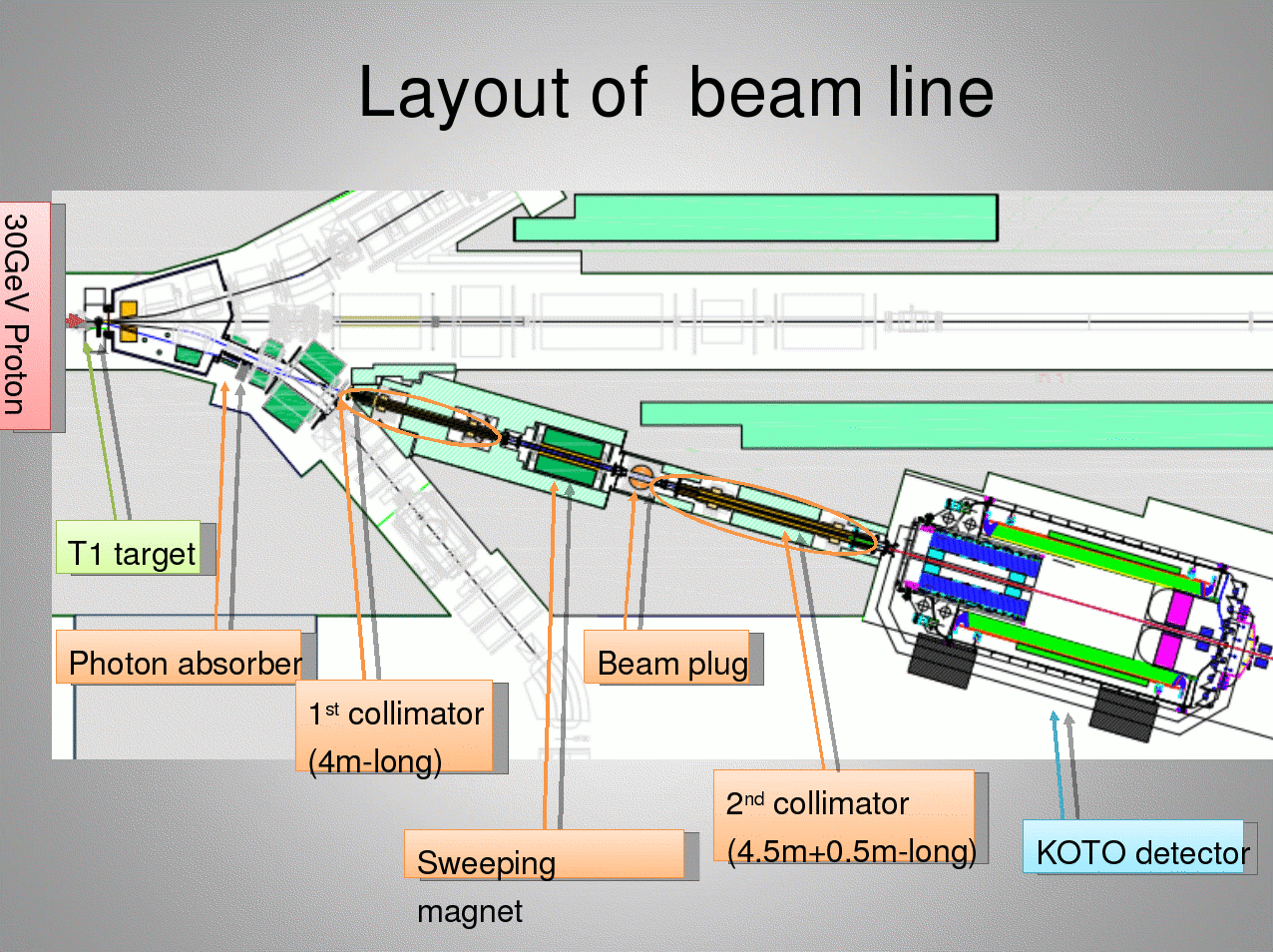
In order to produce the KL, protons are shot at platinum. After a proton hits the nucleus, some particles can be produced.
Then, a magnet bends the particle beam. This way, the beamline is put on some extraction angle, which is 16 degrees. Lead absorbs the photons that we don't want.
The first collimator blocks the particles on one side, so that it minimizes scattering. Sweeping magnet eliminates the charged particles.
The whole beam is about 20 meters long, because it needs to be a pencil beam.
Detector
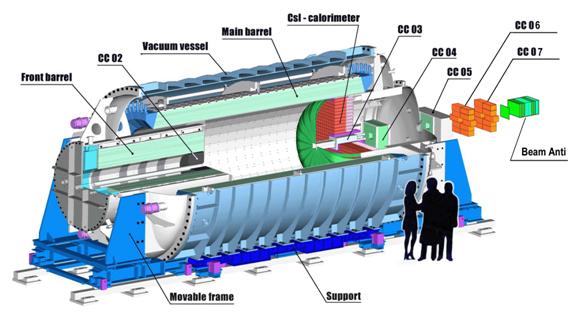
The front barrel together with the CC02 catches the backward-going photons. (These can be produced during the KL decays, their velocity would be opposite to that of the original particle.)
There is a vacuum inside the detector, so that the air molecules wouldn't interefere with the observed particles.
CsI - calorimeter is the most important part of the detector. That's the reason why it was improved since E391a, although the whole detector system didn't change too much. The calorimeter consists of around 3,000 small parts. These are very important for the interaction with the photons. According to their energy, they have different decays which occur in the calorimeter. In the rear part, there is a PMT (photo-multiple-layer) tube, that collects these data. Afterwards, they are reconstructed through computer algorithms so that we can see what particles did they come from.
The PMT can collect these data, because the light creates electro-magnetic signal. Thanks to this, it can be detected through measuring the voltage. This way, the calorimeter determines their energy. In order to determine position and energy with the best precision, the number of subparts and length was increased since E391a.
Article in press about the beamline
Design of the Neutral KoL Beamline for the KOTO Experiment (pdf)
High Energy Physics | 5640 S Ellis Ave | Chicago IL 60637 | +1-773-702-8113
Last update: August 2012
Webmaster: Nina Kuklisova