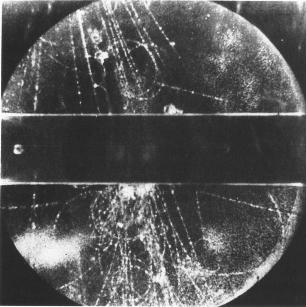
 First V particle (1946). Just below the lead plate, in the lower
right-hand quadrant, an inverted V extends to the lower right. Rochester
and Butler measured the momentum of the upper particle as 300 MeV/c
and determined its charge to be positive. The other (lower) particle has a
negative charge (if it is moving downward) or a positive charge (if it is
moving upward). From past experience, they argued, the two tracks would have
to be closer together to be an electron-positron pair. The two tracks cannot
be a two-track star; if they were, there should be a visible recoiling nucleus
at the apex. Finally, conservation of momentum excludes a pion decaying into
an electron, or a muon decaying into an electron. Since this argument
eliminates the only possible alternatives, Rochester and Butler concluded that
this event had to be a photographic record of a novel phenomenon: the decay of
a previously unknown neutral meson.
First V particle (1946). Just below the lead plate, in the lower
right-hand quadrant, an inverted V extends to the lower right. Rochester
and Butler measured the momentum of the upper particle as 300 MeV/c
and determined its charge to be positive. The other (lower) particle has a
negative charge (if it is moving downward) or a positive charge (if it is
moving upward). From past experience, they argued, the two tracks would have
to be closer together to be an electron-positron pair. The two tracks cannot
be a two-track star; if they were, there should be a visible recoiling nucleus
at the apex. Finally, conservation of momentum excludes a pion decaying into
an electron, or a muon decaying into an electron. Since this argument
eliminates the only possible alternatives, Rochester and Butler concluded that
this event had to be a photographic record of a novel phenomenon: the decay of
a previously unknown neutral meson.
KAON '99
Office of Special Events
The University of Chicago
Chicago, Il. 60637
kaon99@hep.uchicago.edu
FAX: (773) 702-1914
Tel: (773) 702-7480
The timing of this conference is such that important new results in this area can be expected from a variety of collaborations. It will also be a good time to see what new initiatives are in the offing and what theoretical predictions can be incisively tested. This is one of the nicest times of the year in Chicago, considering both the weather and the variety of indoor and outdoor activities available.
The symposium is being hosted by the Department of Physics and the Enrico Fermi Institute of the University of Chicago; Jon Rosner and Bruce Winstein are co-chairpersons of KAON '99.
In addition to the scientific sessions, all of which will be Plenary, we are planning conference receptions, a conference dinner, a concert, and an excursion.
KAON '99 is supported by the Department of Physics, the University of Chicago; and (pending) the NSF, and the DOE.